
Introduction
In today’s increasingly connected world, the term “Wattip” has begun popping up in two very different but equally important contexts:
- As a smart energy monitoring system (hardware + software) used to measure and optimize electrical power usage in homes, businesses, and industrial settings.
- As a social media/community platform focused on authentic, meaningful user interactions and privacy‑centric design.
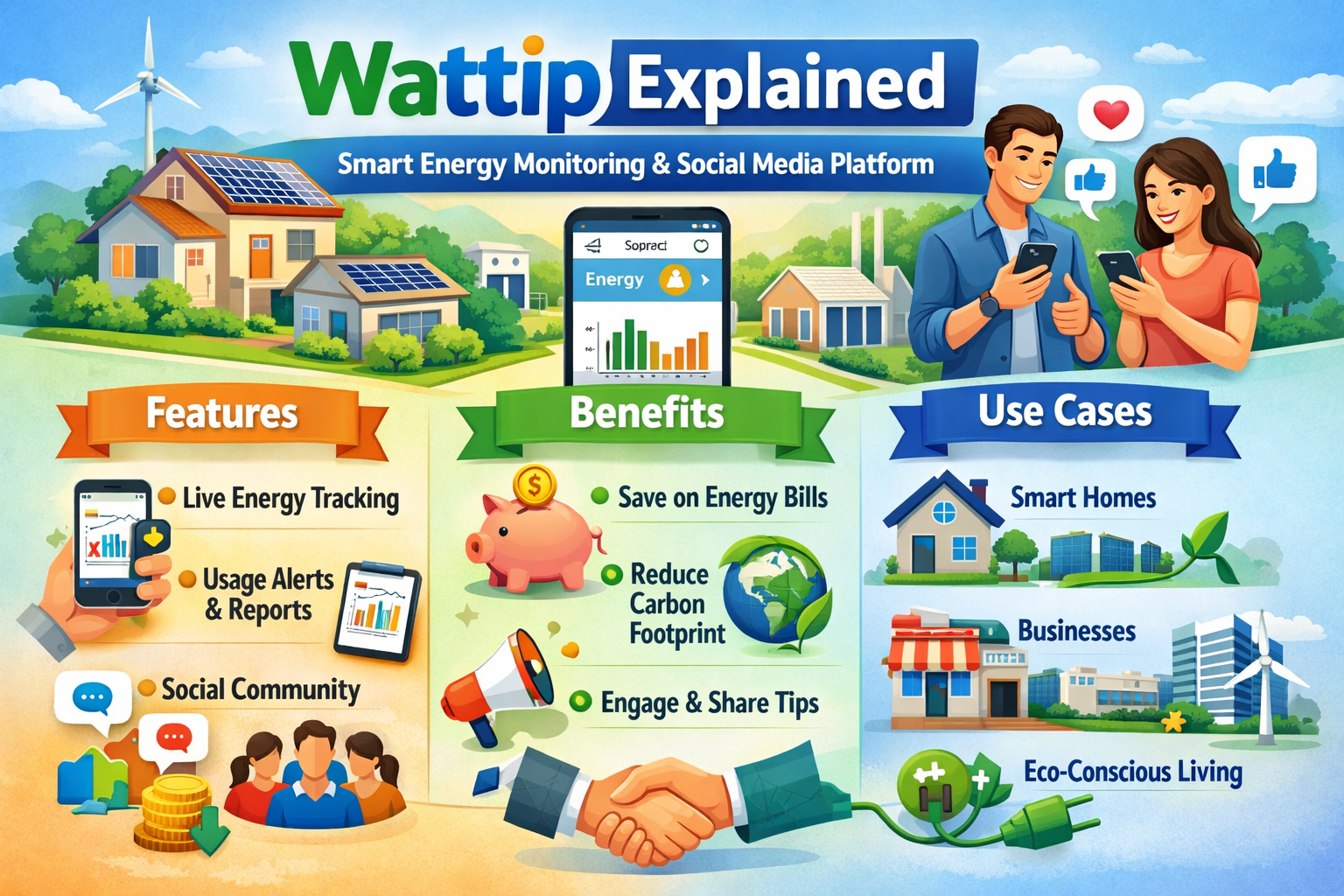
This comprehensive guide dives into both meanings of Wattip, explains how each works, explores major features and benefits, and provides actionable insights for users, businesses, and decision‑makers.
1. Introduction: What is Wattip?
The name Wattip combines two ideas: “Watt” — the unit of power — and “IP” — referring to ingress protection ratings that ensure hardware durability. In energy contexts, Wattip refers to a class of devices that measure energy consumption reliably while being protected from real‑world conditions like dust and water.
Separately, in the social media world, Wattip has been used as a conceptual or brand name for platforms emphasizing privacy, user control, and meaningful interactions without the noise and data exploitation of mainstream social networks. Whether you’re optimizing energy or your online connections, Wattip captures the idea of smarter, more intentional use of technology.
2. Wattip as a Smart Energy Monitoring System (IoT & IP Devices)
2.1 What Wattip Means in Energy Monitoring
When used in the energy and IoT space, Wattip refers to systems that combine precise energy measurement (in watts and kilowatt‑hours) with IP‑rated rugged hardware capable of withstanding harsh environments — from outdoor lighting to industrial machinery. These systems feed real‑time data into dashboards that help users understand, optimize, and reduce energy consumption.
2.2 How Wattip Works: Hardware, Firmware, and Cloud
A typical Wattip energy system includes three layers:
- Hardware Layer
- Sensors such as shunts, clamp‑on CTs, or integrated meters measure electrical current and voltage, calculating real‑time power and cumulative energy data.
- Devices are housed in weatherproof enclosures with IP ratings (like IP65 or IP67) to resist dust, sprays, and immersion.
- Sensors such as shunts, clamp‑on CTs, or integrated meters measure electrical current and voltage, calculating real‑time power and cumulative energy data.
- Firmware & Edge Processing
- Onboard firmware samples data frequently, filters out noise, and logs critical events like spikes or outages.
- Some devices include automation features such as local load shedding or alerts when usage exceeds thresholds.
- Onboard firmware samples data frequently, filters out noise, and logs critical events like spikes or outages.
- Cloud/Software Layer
- Measurement data is streamed to dashboards or apps showing usage trends, device‑level breakdowns, alerts, and savings opportunities.
- Advanced analytics can disaggregate loads to identify which appliances are using energy.
- Measurement data is streamed to dashboards or apps showing usage trends, device‑level breakdowns, alerts, and savings opportunities.
This stack turns raw electrical signals into actionable insights for energy optimization.
2.3 Key Features to Look for in Wattip Devices
When choosing a Wattip or Wattip‑style solution, consider these must‑have features:
- True Power & kWh Monitoring — measure real power, not just voltage or current.
- Robust IP Rating — essential for outdoor or industrial applications.
- Real‑Time Telemetry & Historical Logs — live dashboards and downloadable reports.
- Secure Connectivity — authenticated APIs and encrypted communication.
- Alerts & Automation — thresholds, alerts, and even automated control.
- Interoperability — MQTT, Modbus, BACnet integrations for broader building systems.
Devices that combine these features deliver more reliable performance and deeper insights.
2.4 Benefits of Using Wattip in Energy Management
Energy Efficiency & Cost Savings
Real‑time monitoring reveals inefficiencies like phantom loads and poorly configured equipment. Organizations that act on these insights often see meaningful reductions in energy costs within months.
Globally, the broader IoT energy management market is projected to expand from roughly $70.6 billion in 2023 to about $222.6 billion by 2030, driven by efficiency and sustainability investments.
Durability & Reduced Maintenance
IP‑rated enclosures resist dust, moisture, and environmental wear, translating to lower maintenance costs and longer asset life.
Safety & Reliability
Automated monitoring detects abnormal consumption before failures occur, improving operational safety and uptime.
Sustainability Reporting
Metered data is essential for ESG reports, allowing organizations to document energy performance and carbon reductions.
Operational Insight & Automation
From peak load shedding to predictive maintenance, Wattip systems help reduce operating costs while improving reliability.
2.5 Applications and Use Cases
Wattip devices excel in many settings:
- Residential Homes & Smart Homes — per‑circuit monitoring, EV charging optimization.
- Commercial Buildings — tenant billing, HVAC schedule optimization.
- Industrial Environments — energy‑intensive machinery, quality power analytics.
- Municipal Infrastructure — street lighting, traffic signals, public assets exposed to weather.
- Renewables & Microgrids — matching renewable generation to load and storage dispatch.
The flexibility of Wattip makes it useful from a home garage to a city‑wide energy management strategy.
2.6 Case Studies: Real‑World Results
Across industries, smart monitoring solutions like Wattip often help organizations:
- Achieve double‑digit percentage reductions in energy bills.
- Reduce maintenance costs by detecting faults early.
- Improve energy efficiency with actionable trend insights.
These results underscore the practical ROI potential of granular, real‑time energy data.
2.7 Common Challenges and Misconceptions
- “Wattip is too expensive.” — While upfront costs can be higher, lifecycle benefits and avoided downtime often justify the investment.
- “Installation is plug‑and‑play.” — Some setups require professional electricians, especially when dealing with mains circuits.
- “All devices are the same.” — Validate accuracy, IP certification, security practices, and support before selecting a vendor.
2.8 How to Choose and Install Wattip Devices
To choose the right Wattip solution:
- Define your goals — cost savings, load management, fault detection?
- Audit your loads — list major circuits and peak demands.
- Select measurement technology — clamp sensors for retrofit; panel‑integrated meters for accuracy.
- Pick appropriate IP ratings — based on exposure.
- Plan communications — Wi‑Fi for indoors; LoRaWAN or cellular for remote locations.
- Ensure secure firmware and update support.
For installation:
- Use professional electricians for mains access.
- Place current transformers correctly to avoid errors.
- Commission meters under actual load.
- Adjust alert thresholds as you learn typical behavioral patterns.
This systematic approach ensures accurate readings and reliable alerts.
3. Wattip as a Social Media / Community Platform
3.1 Understanding Wattip’s Mission
In the social networking space, Wattip has been referenced conceptually as a platform that prioritizes privacy, meaningful connections, and user‑controlled data sharing — contrasting sharply with algorithm‑driven mainstream networks where engagement is often driven by advertising imperatives.
This trend toward privacy and user control is part of a broader shift in social platforms where encrypted messaging and decentralized communities are gaining traction.
3.2 Problems with Traditional Social Media Platforms
Large social networks often prioritize profitability over user experience, leading to:
- Algorithms that amplify sensational or irrelevant content.
- Extensive data collection with limited transparency.
- Toxic environments and privacy concerns, particularly for minors. Major investigations into platform practices highlight ongoing privacy and safety issues.
These issues have eroded trust and opened space for alternative platforms that emphasize user control, privacy, and quality interactions.
3.3 How Wattip Solves These Problems
Platforms like Wattip aim to:
- Prioritize user privacy with strong controls over shared data.
- Use encryption for secure messages and private interactions.
- Curate content based on genuine interests rather than ad‑driven algorithms.
- Enable community building around shared topics and passions.
Emerging trends in social media (e.g., decentralized networks and privacy‑centric apps) show growing demand for alternatives to traditional platforms, reinforcing the space where Wattip‑style social tools can thrive.
3.4 Features and Benefits
Key features Wattip‑style platforms emphasize:
- Customizable feeds tuned to interests.
- End‑to‑end encrypted messaging and group chats for private communication.
- Interest‑based communities that foster deeper connections.
- Real‑time engagement tools that avoid clutter and noise.
These features create a safer, more intentional digital experience compared to mainstream platforms weighted toward ads and data harvesting.
3.5 Case Studies and Success Stories
Users — from artists to small business owners — find value in platforms prioritizing meaningful engagement:
- Artists building dedicated communities around their work.
- Coaches holding focused discussions without algorithmic interference.
- Businesses engaging customers through relevant, interest‑based content.
These examples illustrate that users increasingly value quality of interaction over quantity of posts or likes.
3.6 Tips for Using Wattip Effectively
To get the most out of a privacy‑centric, community‑focused platform like Wattip:
- Personalize your profile to reflect your identity.
- Engage actively with communities and topics you care about.
- Explore interest groups to connect with like‑minded users.
- Post consistently to remain visible and encourage dialogue.
- Use privacy tools to protect your information and control who sees your content.
4. Comparing the Two Wattips
| Aspect | Energy Monitoring Wattip | Social Platform Wattip |
| Purpose | Measure & optimize energy consumption | Foster meaningful digital connections |
| Core Tech | IoT sensors, IP‑rated hardware, analytics | Privacy tools, curated feeds, encrypted messaging |
| Primary Users | Homes, businesses, utilities | Individuals, creators, communities |
| Value Proposition | Cost savings, durability, operational insight | Authentic engagement, privacy, user control |
Both interpretations of Wattip share a theme: making technology more transparent, useful, and aligned with user priorities — whether in energy or social experiences.
5. Future Trends and Innovations
IoT & Energy Monitoring
- Expansion of energy systems integrating machine learning for predictive insights.
- Growth in smart grid and renewable energy integration with real‑time controls.
- Broader adoption in buildings and city‑wide energy networks.
Globally, the IoT energy management market is projected to grow from about $70.6 billion in 2023 to $222.6 billion by 2030 at a CAGR of roughly 17.8%.
Social Platforms & Privacy
Social media continues evolving with:
- Increased emphasis on data privacy and user control.
- Growth of decentralized platforms and encrypted community tools.
- Shifting user behavior favoring quality engagement over algorithm‑driven noise.
6. Cost, ROI, and Value Proposition
Energy Monitoring Wattip
- Upfront costs: hardware, installation, communication setup.
- Ongoing costs: cloud subscriptions, maintenance.
- ROI drivers: energy savings, reduced downtime, maintenance avoidance, sustainability reporting.
A simple model shows a professional Wattip deployment (~$2,000) with annual savings of $500+ could pay for itself in ~2 years — making it attractive for energy‑intensive sites.
Social Platform Wattip
Value here is user experience and engagement quality, which can translate into stronger communities, better creator monetization, and higher satisfaction compared to mainstream platforms burdened by ads and privacy trade‑offs.
7. FAQ – Quick Answers
Q: Are Wattip energy devices compatible with solar panels?
A: Yes — most energy monitoring systems report both generation and consumption, integrating with inverter APIs where supported.
Q: What IP rating is best for outdoor use?
A: IP65–IP67 is typical for outdoor devices exposed to dust and water jets.
Q: Are Wattip cloud subscriptions required?
A: Many vendors offer optional cloud analytics; local logging options exist for privacy‑focused users.
Q: What privacy trends shape modern social networks?
A: There’s a major shift toward encrypted communication, decentralized platforms, and user‑controlled data sharing.
8. Conclusion: Choosing the Right Wattip for Your Needs
Whether you’re looking to slash energy costs, improve operational insight, and support sustainability goals with a Wattip energy monitoring system — or seeking a more authentic, privacy‑centric social networking experience — the term Wattip represents a move toward smarter, more human‑aligned technology.
By understanding both interpretations and their respective features, benefits, and future trajectories, you’re better equipped to make informed decisions that align with your goals — from energy optimization to better digital connections.
ALSO READ: Meaimee 3 Explained: Meaning, Digital Identity, Content Style, and Conceptual Framework