Introduction to Pxless
In an era where screens vary from tiny wearables to high-definition 8K monitors, designers and developers face a daunting challenge: how to create truly adaptable digital experiences. Enter Pxless — a fresh approach to digital design and development that breaks free from the limitations of fixed pixel measurements and ushers in a future where interfaces fluidly adapt to any device or context.
Pxless isn’t just a buzzword — it represents a shift in how modern digital products are built, maintained, and scaled. By emphasizing resolution independence, scalability, and adaptive logic, Pxless positions itself as a future-ready paradigm for design systems and UI architecture.
Before we dive deeper, it’s important to understand that this concept isn’t isolated. It draws from established principles of responsive design, vector graphics, and performance-centered UX — all of which play a central role in shaping modern user experiences.
What Is Pxless? (Clear & Simple Definition)
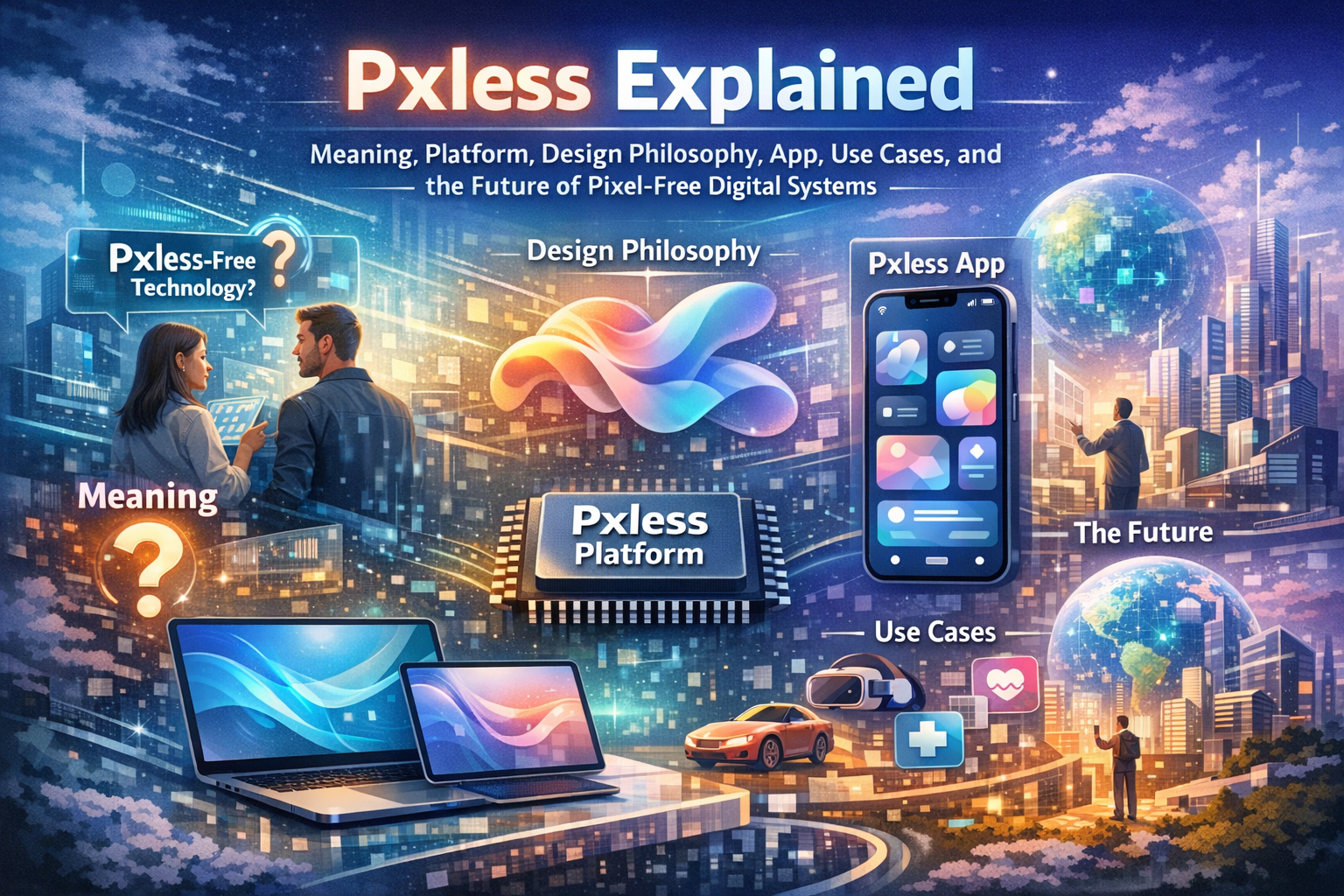
At its core, Pxless (short for pixel-less) is a design philosophy and implementation strategy where traditional pixel-based measurements give way to fluid, scalable, and context-aware interfaces. Rather than anchoring design elements to a static value like 320px, Pxless uses relative units, vector assets, and adaptive constraints to create UI components that respond dynamically to their environment.
A simple analogy would be this:
- Traditional pixel design is like building a brick wall.
- Pxless is like shaping with clay — it adapts to its container.
This fluidity means that elements aren’t resized manually for every device; they grow, shrink, and reflow as needed, resulting in consistent visual clarity and performance no matter the screen or context.
Pxless is both philosophical and technical. Philosophically, it prioritizes user experience first — designing interfaces that feel intuitive regardless of device. Technically, it’s built on modern CSS and component frameworks that handle resolution independence and adaptive scaling automatically.
The Origin and Evolution of the Pxless Concept
Historically, screen design began in an era where screens were relatively uniform. Early interfaces assumed a single or limited range of screen resolutions. That’s why designers traditionally relied on fixed pixel values.
As devices diversified — introducing phones, tablets, foldables, wearables, and VR interfaces — this approach began to break down. The industry responded with responsive web design. Tools like CSS media queries were introduced and standardized to allow layouts to adapt to different screen sizes.
In 2012, the W3C officially recognized media queries as a web standard, solidifying adaptive design as a core web principle. Since then, responsive design has been adopted by over 94% of modern websites, demonstrating that adaptability is now a core requirement rather than an optional luxury.
Pxless evolves this legacy further by moving beyond media-query breakpoints and instead treating interfaces as fluid systems defined by relationships, tokens, and scalable constraints.
Core Principles Behind Pxless
Pxless encompasses several foundational principles that guide both design and development.
Resolution-Independent Design Philosophy
Instead of anchoring sizing to absolute pixels, Pxless relies on relative units like em, rem, %, vw, and vh. These units enable layouts to flex seamlessly across diverse viewports, ensuring readability and usability regardless of device dimensions.
Scalable UI Components and Fluid Layouts
Pxless treats components as living pieces that adjust based on their context. Rather than designing separate versions for desktop and mobile, components scale fluidly, enhancing both consistency and performance.
Vector-First Visual Strategy
Vector graphics — especially SVG (Scalable Vector Graphics) — are at the heart of Pxless visuals. Unlike raster images, SVGs remain sharp at any resolution without increasing load size, which boosts performance and user satisfaction. Libraries that leverage SVGs see improvements in device adaptability and often better visual quality on high-density displays.
Unit-Free and Token-Based Systems
Pxless design systems often employ design tokens — abstract variables that define spacing, typography, and color relationships. Tokens enable consistent scaling across environments and reduce brittle, hard-coded values.
How Pxless Works in Real Digital Environments
The Technology Powering Pxless
Pxless systems are built on top of modern web and app technologies, such as:
- CSS Variables and Functions (calc(), clamp(), min(), max())
- Component-Based Frameworks (React, Vue, Flutter)
- Vector Graphics (SVG)
- Responsive Units and Adaptive Layout Models
For instance, clamp() lets designers define a size that grows and shrinks between minimum and maximum thresholds, providing fluid typography without breakpoints. This aligns with emerging trends in responsive design where typography scales smoothly between device sizes.
Relative Units Explained
Relative sizing allows interfaces to avoid rigid pixel dimensions. For example:
- 1rem scales with root font size.
- vw sizes relative to viewport width.
These approaches result in UI designs that adapt effortlessly without the need for dozens of distinct media queries.
Pxless in Digital Design (UI / UX Perspective)
Design Tokens and Systems Thinking
In Pxless design systems, tokens are the single source of truth for maintaining scale, spacing, and rhythm across an interface. Tokens reduce guesswork and enable cross-platform consistency — whether on web, mobile, or emerging platforms like AR.
Responsive Typography and Spacing
Fluid typography enhances readability on all screens. Studies on responsive practices indicate that fluid layouts aligned with user context can reduce bounce rates and increase engagement versus rigid layout systems.
Minimalism, Accessibility, and User-First Design
Pxless often promotes minimalist UI because eliminating rigid metrics clarifies content hierarchy. Inclusive design — such as strong contrast and scalable icons — becomes easier when elements adapt rather than rely on predetermined sizes.
Pxless in Web Development
Support in Modern Frameworks
Frameworks like React and Next.js simplify the implementation of scalable components. They allow developers to define flexible layouts that respond dynamically to available space.
Utility-first CSS frameworks like Tailwind CSS make Pxless adoption more intuitive by prioritizing relative spacing utilities and responsive units like vw, vh, and rem.
Reducing Media Query Dependence
While media queries are still foundational, Pxless pushes designers away from breakpoint-centred thinking toward contextual logic. Techniques like container queries — now supported in most modern browsers — enable component-level adaptability.
Pxless as a Platform (App & Creator Tools)
Pxless isn’t only a design philosophy — it is also embodied in modern creator tools and platforms. These tools often include:
- Project and asset organization
- Scalable visual components
- Collaboration features across teams
- Version tracking and review workflows
Mobile and desktop apps let creators manage designs and assets on the go, making it easier to maintain component libraries and implement changes widely. By integrating workflow tools with Pxless principles, creators reduce friction and improve consistency.
Payments and Security in Pxless
For creators selling digital assets or subscription services within Pxless platforms, secure payment integrations are essential.
Platforms may offer features such as:
- Built-in payment gateways
- Trust login systems for secure authentication
- Multi-currency support for international clients
These integrations ensure that creative professionals can focus on producing and managing work, without worrying about transactional interruptions or security gaps.
Pxless in Software, SaaS, and Technology
SaaS UI Scalability
Software companies benefit particularly from Pxless — complex dashboards and product UIs retain clarity across devices and user preferences.
Cross-Platform UI Support
Frameworks like Flutter and React Native make it feasible to build adaptable UI components that run on iOS, Android, and desktop, minimizing duplication and technical debt.
Cloud-Based Workflow Integration
Modern design systems often reside in cloud environments, enabling teams to sync design tokens, component libraries, and updates in real time.
Pxless in Marketing and Branding
In digital marketing, asset clarity and performance are crucial. Pxless ensures marketing visuals consistently look sharp and load quickly on all devices — from billboards to phones — improving engagement and conversion outcomes.
Benefits of Pxless for Businesses and Creators
Higher Visual Quality With Fewer Assets
Vector-based and scalable assets reduce redundancy, storage, and bandwidth.
Improved User Experience
Fluid layouts and adaptable typography foster smoother interactions and increase session duration.
Studies have shown that responsive and adaptable interfaces can increase engagement and reduce bounce rates, especially on mobile devices where proper scaling is critical.
Cost Savings and Efficiency
Pxless workflows often mean fewer iterations and less maintenance because assets and components only need one scalable version instead of many fixed sizes.
Future-Proofed Design Infrastructure
With new device categories always emerging, Pxless ensures compatibility without constant redesign.
Practical Use Cases of Pxless
Websites and Responsive UI Systems
From blogs to enterprise dashboards, fluid layouts enhance usability across screen sizes.
E-Commerce Platforms
Product visuals that scale infinitely improve customer perceptions and reduce page weights.
SaaS Dashboards
Complex datasets and UI elements reflow smoothly in Pxless systems.
AR, VR, and IoT Interfaces
In environments where pixel concepts don’t apply, Pxless principles of scalability and context response are essential.
Pxless vs Traditional Pixel-Based Design
| Feature | Traditional | Pxless |
| Units | Fixed pixels | Relative units |
| Scalability | Limited | Seamless |
| Maintenance | Multiple assets | Single scalable asset |
| Device Support | Harder | Adaptive |
| Performance | Varies | Optimized |
While pixel-based design still has use cases (e.g., print, static layouts), Pxless excels in environments that prioritize adaptability, performance, and consistency.
Tools, Frameworks, and Technologies Supporting Pxless
Top tools include:
- Figma
- Webflow
- Tailwind CSS
- React
- Vue
- Flutter
CSS features like clamp(), container queries, and CSS variables are foundational to implementing Pxless systems.
Challenges and Limitations of Pxless
Despite its advantages, Pxless isn’t a magic solution.
- Learning curves exist for existing teams.
- Legacy browser support requires fallbacks.
- Migration from pixel-based systems may be incremental.
Good documentation and quality testing are essential to manage regressions.
How to Transition to Pxless (Step-by-Step Guide)
- Audit assets for fixed metrics.
- Define design tokens for relative values.
- Update components incrementally.
- Adopt scalable frameworks and tools.
- Test across devices regularly.
The Future of Pxless in the Digital World
Pxless aligns with trends like:
- AI-assisted design optimizations
- AR/VR interfaces
- Voice-first UIs
- Ambient computing
By prioritizing adaptability, Pxless may become a best-practice standard similar to responsive web design.
Frequently Asked Questions (FAQs) About Pxless
What is Pxless in simple words?
Pxless is a design and development approach that avoids fixed pixel values and uses scalable, adaptive units and systems to build interfaces that work across devices.
Is Pxless replacing pixel-based design?
Not entirely, but it’s rapidly becoming preferred for modern digital products that demand scalability and performance.
Who can adopt Pxless?
Designers, developers, and creators seeking flexible, future-proof workflows benefit most.
Is Pxless future-proof?
Yes — its core principles align with emerging technologies and device trends.
Final Summary
Pxless represents a pivotal evolution in digital design and development — one that embraces adaptability, performance, and scalability at its core. By moving away from rigid pixel constraints and toward fluid, relative systems, it provides better user experiences, streamlined workflows, reduced maintenance costs, and future-ready components that grow with device evolution.
By understanding and implementing Pxless principles, teams can build products that are not only beautiful and functional but also resilient in the face of a rapidly changing digital ecosystem.
ALSO READ: Serlig: The Ultimate Guide to Digital Creativity, Online Content, and Creator Success