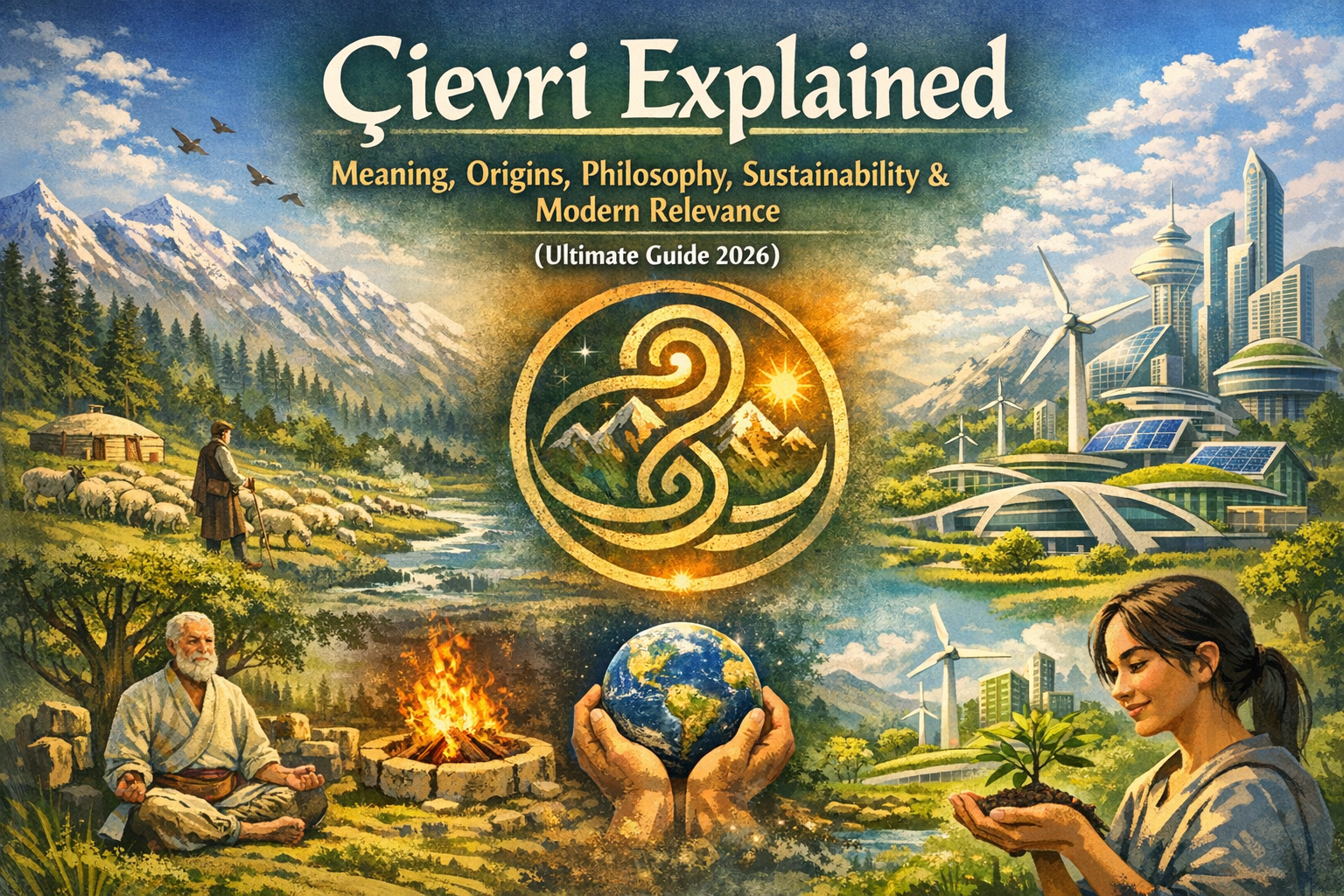
In a world increasingly shaped by fast-paced change, global challenges, and a collective search for meaning, çievri has emerged as a timeless yet modern concept. It bridges ancient wisdom with contemporary needs — offering insights into how we understand cycles, balance, sustainability, and human experience.
This definitive guide explores çievri in depth — from its linguistic roots and philosophical dimensions to its relevance in education, technology, culture, and sustainability. By the end, you’ll have a full understanding of why çievri matters in 2026 and beyond.
What Is Çievri? A Clear and Simple Explanation
The Core Meaning of Çievri
At its heart, çievri refers to the idea of cycles, continuity, and dynamic balance. Instead of viewing life as a straight path from point A to B, çievri frames existence as a series of interconnected loops — where beginnings blend into endings and endings give rise to new beginnings.
It’s a concept rooted in movement, return, and harmony across systems, whether in nature, human experience, or social life.
Why Çievri Is More Than Just a Word
While the term appears in some traditional contexts, it is less like a dictionary entry and more like a guiding worldview. Çievri is not fixed to one discipline — it applies to how we think, learn, innovate, live sustainably, and relate to each other.
Put simply:
Çievri is a lens for understanding continuity, interdependence, and balanced progress.
Çievri as a Concept of Cycles, Balance, and Continuity
Unlike linear progress models — where growth is measured by accumulation — çievri emphasizes movement in cycles, where progress is measured by harmony, renewal, and sustainability.
This distinction is crucial:
- Linear thinking prioritizes more.
- Cyclical thinking emphasizes balance.
In a world challenged by resource limits, mental overload, and cultural friction, this orientation offers a new way to align human systems with natural rhythms.
Linguistic and Cultural Origins of Çievri
Turkic Roots and Historical Background
The linguistic roots of çievri trace back to Turkic traditions, where words related to turning, returning, and cyclical movement described seasonal life, rituals, and cosmic harmony.
Although not always recorded in formal dictionaries, the term reflects oral knowledge systems — languages and cultural narratives passed down through generations.
Early Turkic societies — from the Central Asian steppes to Anatolian regions — viewed time and life as loops rather than straight lines. Seasonal festivals, birth–death rituals, and agricultural practices all mirrored this understanding.
Oral Traditions and Symbolic Usage
In many traditional cultures, cyclical symbols appear across mythology:
- Sun cycles representing life and rebirth.
- Water and rain cycles symbolizing renewal.
- Lunar rhythms marking time and community calendars.
Çievri captures this symbolism. It’s not purely technical; it’s cultural, ecological, and embodied in shared memory.
Common Misinterpretations and Clarifications
Because the word looks distinctive, some may confuse it with linguistic terms related to translation or language conversion. But çievri — as used in philosophy and culture — stands apart:
- Not translation
- Not conversion
- Not a fixed definition
Instead, it’s about pattern and principle.
Çievri vs Similar Terms (What It Is Not)
Many concepts overlap with çievri — such as mindfulness, renewal theory, and systems thinking — but each differs:
| Concept | Primary Focus | Difference from çievri |
| Mindfulness | Present awareness | Çievri includes time cycles & systems beyond present moment |
| Renewal | Restoration | Çievri embeds renewal within cycles |
| Systems thinking | Interrelations | Çievri adds cultural & philosophical depth |
The Philosophy Behind Çievri
Cyclical Thinking vs Linear Progress
Modern Western frameworks often favor linear progress—a sequence: start → grow → finish. Çievri challenges this by asserting:
Meaningful progress resembles a circle, not a straight line.
In practical terms:
- Mistakes are not endpoints but loops to return to
- Growth is recursive, not one-time
- Understanding deepens through repetition, not acceleration
This philosophical stance aligns with many traditional wisdom systems — from Eastern philosophies to Indigenous knowledge.
Balance as a Dynamic Process
In çievri, balance is not stasis. It’s an ongoing negotiation between forces:
- Expansion ↔ Contraction
- Action ↔ Rest
- Innovation ↔ Preservation
Rather than resisting change, balance is achieved by adapting with cycles.
Renewal, Return, and Repetition in Human Life
Çievri sees patterns everywhere:
- Learning through practice and revisiting
- Emotional growth through reflection
- Career development via iterations, not milestones
Life, in this view, is a recurring sequence of experience, reflection, adaptation.
Çievri and the Nature of Time
Time, through the lens of çievri, is layered, not linear. Each cycle includes echoes of the past and seeds of the future, meaning events connect across space and time.
This contrasts with clock-based time and invites a relational understanding of duration and change.
Çievri as a Symbol of Natural Cycles
Seasons, Ecosystems, and Regeneration
Nature is the most vivid classroom for çievri:
- Spring → Renewal
- Summer → Growth
- Autumn → Decline
- Winter → Rest
These repeating cycles show that endings are not final — they are essentials parts of regeneration.
Ecosystems follow similar loops:
- Forest fires → regrowth
- Water evaporation → rainfall
- Soil decay → nutrient renewal
Such patterns reveal that life depends on interconnected repetition, not linear accumulation.
Adaptation Instead of Control
Çievri emphasizes adaptive harmony with nature, not domination. Sustainable living involves learning from rhythms rather than imposing artificial timelines.
This perspective is consistent with research showing that long-term ecological balance relies on regeneration and cyclical resource use — not extraction and depletion.
Long-Term Balance Over Short-Term Gain
On economic and social fronts, çievri suggests:
- Investment in renewable systems
- Respect for ecological limits
- Decisions that benefit future cycles, not immediate profit
This contrasts sharply with short-term metrics that dominate many modern societies.
Traditional Ecological Wisdom and Çievri
Across cultures — from Indigenous land stewardship to ancient farming methods — ecological knowledge embraced cycles:
- Crop rotation
- Seasonal harvesting
- Water conservation
Çievri formalizes this wisdom into a cohesive worldview relevant for modern sustainability.
Çievri as a Lifestyle and Mindset
Intentional Living Through Cyclical Awareness
Living with çievri means being mindful of rhythm:
- Sleep cycles
- Work–rest balance
- Personal growth patterns
It’s about listening to inner and outer rhythms — not resisting them.
Slowing Down Without Stopping Growth
Slowing does not mean stopping. Çievri supports pacing that:
- Improves clarity
- Enhances reflection
- Supports emotional balance
This approach counters burnout and stress — common in modern life.
Creating Mental Space in a Fast World
In an age of constant connection, mental space is essential. Çievri invites:
- Intentional pauses
- Reflective breaks
- Time for internal renewal
Such practices are linked to improved well-being and resilience.
Çievri and Emotional Resilience
Understanding life as cycles builds resilience:
- Challenges become phases, not endpoints
- Success is part of ongoing learning
Emotional flexibility grows by accepting ups and downs as usual parts of life.
Çievri and Mental Well-Being
Cognitive Balance in the Age of Information Overload
Today’s digital environments demand rapid attention and continuous engagement — leading to cognitive overload.
Çievri encourages:
- Mindful consumption
- Reflective breaks
- Prioritizing depth over speed
These practices help reduce stress and support sustainable cognitive health.
Reflection, Rest, and Renewal
Studies show that rest and reflection are key to creativity and learning retention. Çievri supports these naturally by valuing cycles of engagement and renewal.
Çievri vs Mindfulness (Key Differences)
Though similar to mindfulness, çievri diverges in two ways:
- Temporal focus — mindfulness centers on the present moment; çievri spans cycles over time.
- Systemic integration — mindfulness is personal; çievri integrates personal, social, cultural, and ecological systems.
Social and Community Dimensions of Çievri
Intergenerational Responsibility
Çievri insists that today’s actions echo into future cycles. This idea reinforces responsibility to future generations — a principle also central to sustainability and cultural continuity.
Cultural Continuity and Adaptation
Communities evolve without losing identity when they embrace cyclical continuity. Traditions transform rather than vanish — echoing the çievri mindset.
Collective Identity and Shared Cycles
Shared rituals — seasonal festivals, life-cycle ceremonies, agricultural calendars — reflect collective awareness of repeating patterns.
Çievri provides a framework for connecting individual meaning with shared cultural rhythms.
Community Decision-Making Through Çievri
When communities view decisions as part of long-term cycles, they tend to:
- Plan for long-range effects
- Balance immediate needs with future impact
- Preserve cultural and ecological harmony
Çievri and Sustainability in the Modern World
Sustainability as a Continuous Cycle
Modern sustainability often focuses on fixed goals. Çievri reframes sustainability as an ongoing loop — adaptive, responsive, and evolving.
This reframing:
- Encourages regenerative systems
- Rejects “one-and-done” solutions
- Emphasizes continuous improvement
Regenerative Thinking and Resource Renewal
In regenerative models (e.g., regenerative agriculture or circular economies), materials, knowledge, and energy remain in cyclical flows — not waste streams.
Çievri aligns perfectly with such models by focusing on movement and renewal, not extraction and discard.
Environmental Responsibility and Natural Limits
Human activity must stay within ecological limits if long-term balance is desired. Çievri reminds us that causes produce future effects, urging responsible choices for future cycles.
Çievri vs Traditional Sustainability Models
Traditional sustainability often targets status maintenance. Çievri goes further — targeting dynamic health over time, adapting systems to cycles rather than stabilizing them in artificial equilibrium.
Çievri in Education and Learning Systems
Cyclical Learning and Deep Understanding
Learning is rarely linear. Real mastery involves:
- Introduction
- Practice
- Reflection
- Revision
- Reintegration
This mirrors cyclical patterns and supports deeper retention.
Reflection, Revision, and Long-Term Knowledge
Most educational research shows that spaced practice and reflection improve learning outcomes. Çievri supports this by valuing iterative learning paths.
Applying Çievri in Modern Education Models
Innovative learning environments are increasingly embracing:
- Continuous feedback
- Reflective assignments
- Self-paced cycles
…all consistent with çievri principles.
Çievri in Technology and Human-Centered Innovation
Human-Centered Artificial Intelligence
Technology designed around human needs — not just speed or volume — reflects çievri thinking:
- Interfaces that reduce overload
- AI that supports understanding
- Tools that enhance clarity
Rather than maximizing engagement, çievri-oriented tech maximizes meaningful interaction.
Ethical and Responsible Technology Design
Ethical design means:
- Respecting user cognitive limits
- Avoiding addictive patterns
- Supporting reflection and rest
These align with çievri’s rhythm-based principles.
Çievri in Digital Tools and Productivity Systems
Modern productivity tools emphasize:
- Deep work
- Balanced schedules
- Habit loops
These reflect cyclical rather than linear productivity models.
Reducing Cognitive Overload Through Design
By prioritizing quality over quantity, cycles of focus and rest help avoid burnout — a central goal for human-centered design.
Çievri in Creativity, Art, and Contemporary Thought
Cyclical Narratives and Creative Expression
Artists and writers often use cycles:
- Repeating motifs
- Evolving stories
- Themes of return and transformation
Çievri offers a powerful metaphor for creative cycles and innovation.
Identity, Transformation, and Return
Creative exploration often returns to core themes, reshapes them, and expresses them again — mirroring cycles of transformation.
Such patterns resonate with audiences because they reflect deeper patterns of human experience.
Why Creators Are Drawn to Çievri
Creativity thrives in loops — idea, execution, reflection, re-creation — making çievri a natural metaphor for artistic processes and creative ecosystems.
Why Çievri Matters in 2026 and Beyond
Responding to Environmental and Social Challenges
Global challenges — climate change, societal fragmentation, mental health crises — demand holistic perspectives. Çievri supplies a framework that:
- Honors cycles of systems
- Recognizes interconnectedness
- Prioritizes long-term balance
Çievri as an Alternative to Consumption-Driven Progress
Economic models driven by consumption often ignore limits. Çievri favors quality, renewal, continuity, and responsible cycles.
Global Relevance of Cyclical Thinking
Across cultures, people increasingly seek meaning beyond short-term gains. Çievri speaks to:
- Sustainability advocates
- Educators
- Designers
- Cultural stewards
- Individuals seeking balance
Its universality makes it relevant across disciplines and regions.
The Future of Çievri and Conscious Innovation
Aligning Human Values, Technology, and Nature
The future requires systems that:
- Support human well-being
- Respect ecological limits
- Honor cultural continuity
Çievri frames innovation as responsible, intentional, and harmonious.
Long-Term Thinking in a Rapid World
Even as technology accelerates, çievri encourages:
- Reflective innovation
- Sustainable cycles
- Lifelong adaptation
This answers the need for balance in a hyper-connected world.
Çievri as a Framework for the Future
By integrating:
- Philosophy
- Ecology
- Culture
- Technology
çievri offers a holistic framework for navigating complexity and building resilient systems.
Conclusion: Çievri as a Continuous Cycle of Awareness and Renewal
Çievri is more than a concept — it’s a way of seeing the world.
It teaches that cycles — not linear timelines — shape life, learning, culture, and sustainability. By embracing cycles of renewal, reflection, and interdependence, we can live with greater balance, purpose, and responsibility.
In a future marked by both challenge and innovation, çievri offers practical and philosophical guidance for individuals and societies seeking harmony across time.
Frequently Asked Questions About Çievri
What does çievri mean in simple terms?
Çievri refers to the idea of cycles, balance, and interconnected movement, emphasizing continuity in life, nature, and society.
Is çievri a real word or a philosophy?
It has linguistic roots in Turkic traditions but is used more as a conceptual philosophy than a standard dictionary term.
How is çievri different from mindfulness?
Mindfulness focuses on present awareness. Çievri includes cycles over time, spanning personal, cultural, ecological, and technological systems.
Can çievri be applied in daily life?
Yes. It can guide:
- Personal habits
- Learning strategies
- Work–rest balance
- Sustainable choices
Is çievri connected to sustainability?
Strongly. Çievri promotes long-term balance, responsible resource use, and regenerative cycles consistent with sustainability.
Why is çievri becoming popular now?
As societies confront ecological limits and mental overload, cyclical frameworks like çievri offer resilience, continuity, and balanced progress.
ALSO READ: Serlig: The Ultimate Guide to Digital Creativity, Online Content, and Creator Success