
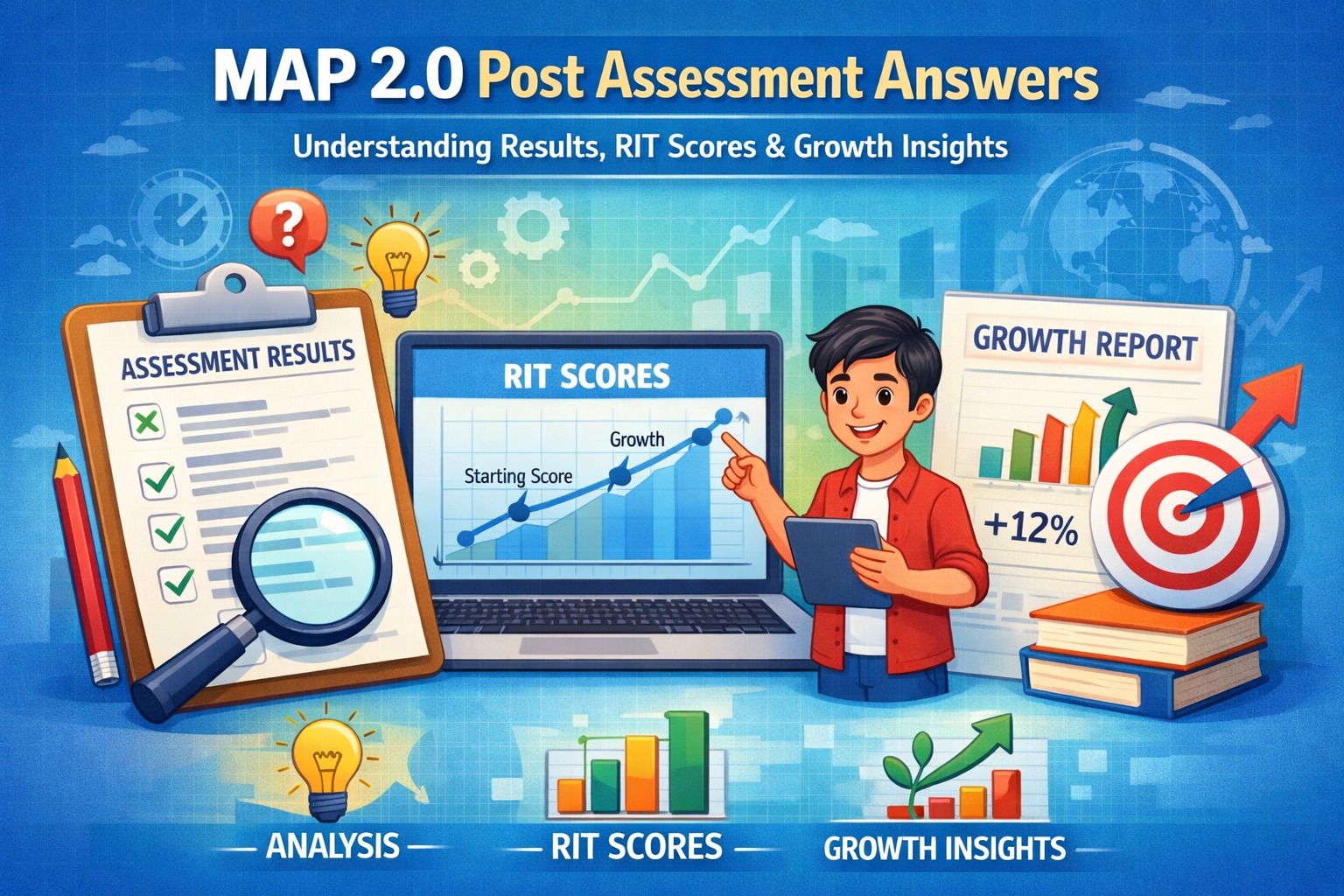
Understanding what MAP 2.0 post assessment answers really means can transform confusion into clarity and empower students, parents, and educators alike to use test data in meaningful ways. Unlike traditional exams with one fixed answer key, MAP 2.0 is built to capture individual academic growth — not simply right or wrong answers. In this guide, we’ll break down everything you need to know about MAP 2.0 post assessment results, how to interpret them, and how to act on them for academic success.
Introduction to MAP 2.0 Post Assessment Answers
When students finish a MAP 2.0 test, it’s common for them or their parents to search for “post assessment answers.” The reason? People instinctively want to see correct answers, understand their performance, and figure out areas to improve — just like with a typical school test.
However, MAP 2.0, also called MAP Growth, works differently. Instead of a static list of questions followed by a fixed answer key, MAP uses adaptive logic that adjusts question difficulty based on the student’s responses. Because of this, there is no universal set of post assessment answers. What students do get are detailed personalized reports that reveal strengths, learning needs, and growth over time — the real value in this assessment model.
How MAP 2.0 Assessment Works
Adaptive Testing: Tailored Questions for Every Student
MAP 2.0 is designed as a computer‑adaptive assessment. After each response, the system adjusts the difficulty level of the next question upwards or downwards. This ensures that each student encounters a unique set of items tailored to their ability, making the assessment personalized and accurate.
This adaptive feature explains why there is no single question set or answer sheet — every test look different from one student to the next. Instead of ranking students against each other, MAP identifies where each student is academically and how they’ve grown.
Subjects Covered in MAP 2.0
MAP tests are typically offered in core academic areas such as:
- Mathematics
- Reading
- Language Usage
- Science (in some implementations)
This gives a well‑rounded snapshot of student performance across multiple critical skill domains.
Focus on Growth Over Grades
Unlike traditional exams that emphasize a percentage score or letter grade, MAP growth emphasizes progress and learning trajectory. Each result is tied to how much a student has grown over time, not just whether they “passed” or “failed.”
This approach aligns with modern educational philosophy that views learning as a continuum rather than a single event.
Understanding Post Assessment Results
Why There Is No Universal Answer Sheet
Many learners search for “post assessment answers” hoping to see a list of correct answers. Unfortunately, because MAP 2.0 tests are adaptive and unique to each test‑taker, there’s simply no universal answer key. Any website claiming to offer a complete answer sheet for MAP 2.0 should be treated with skepticism.
This is by design — releasing answer keys would undermine the integrity of adaptive testing and skew growth data.
Key Elements of Post Assessment Reports
Instead of traditional answers, MAP provides several key data points in its post assessment reports:
1. RIT Score — The Core Measurement
The RIT score (Rasch Unit) is the central indicator of student performance. It measures a student’s instructional level on an equal interval scale — similar to a ruler — so that a 10‑point gain always means approximately the same learning difference, regardless of whether a student is in early elementary or high school.
RIT scores are grade‑independent and allow tracking of academic progress over time rather than comparison to grade averages.
2. Growth Comparisons Over Time
MAP reports usually show how a student’s RIT score has changed across testing windows — typically fall, winter, and spring. This shows whether a student is growing at, above, or below expected rates.
3. Skill Area Breakdown
Instead of focusing on individual item correctness, reports often reveal goal areas or skill clusters where a student performed well or may need extra support. These may include algebraic thinking in math or comprehension categories in reading.
4. National Percentile Rank
In many MAP implementations, the results include a national percentile rank, which compares a student’s performance to a national sample of peers in the same grade.
This contextualizes how a student is performing relative to others without reducing learning to pass/fail.
How to Interpret MAP 2.0 Post Assessment Answers
Interpreting MAP results is less about “what answers did I get right?” and more about understanding what learning level the student has reached.
For Students: Identifying Strengths and Weaknesses
Students and parents should use post assessment feedback to:
- Identify areas of strength
- Recognize topics needing further practice
- Set achievable growth goals for the next test cycle
For example, a higher RIT score in reading suggests a student can handle more complex texts; a lower relative score in math could signal targeted focus areas.
For Educators: Tailoring Instruction
Teachers use MAP data to:
- Differentiate instruction based on current skill levels
- Group students for targeted learning experiences
- Adjust pacing to focus more on areas where many students struggle
- Evaluate curriculum effectiveness over time
For Parents: Supporting Learning at Home
Parents can interpret MAP reports meaningfully by:
- Asking teachers to explain RIT scores
- Helping students build habits around foundational skills
- Reinforcing learning goals at home
- Using instructional area breakdowns to guide practice
These efforts make MAP a shared tool for growth rather than a source of anxiety.
Common Misconceptions About MAP 2.0 Post Assessment
Misconception 1: There Is a Printable Answer Key
This is one of the biggest myths. Because every MAP test adapts in real time, the question set is individualized and proprietary — meaning there’s no answer sheet students can access after testing.
Misconception 2: RIT Scores Are Like Traditional Grades
Unlike percentage scores or letter grades, RIT scores are growth‑oriented and measure instructional level rather than mastery of a single test form.
Misconception 3: Low Scores Mean Failure
Not necessarily. A student with a “low” RIT compared to grade norms may nonetheless show strong growth — which is the more important indicator of learning over time.
Misconception 4: Students Can Improve by Memorizing Answers
Since MAP questions are adaptive and draw from thousands of items, memorization of sample questions or answers has minimal value. Instead, targeted skill development is far more effective.
Tips for Maximizing Future MAP 2.0 Performance
While searching for “post assessment answers” won’t help on future tests, there are effective strategies that do:
1. Focus on Skill Development
MAP rewards actual growth. Practice comprehension, problem solving, and logic skills rather than memorizing specific item types or examples.
2. Familiarize With Test Interface
Students who understand how MAP works — including adaptive shifts in difficulty — are more comfortable during the assessment.
3. Regular Review of Learning Targets
Use teacher feedback and instructional area data from reports to guide weekly study routines.
4. Maintain Healthy Test Practices
Ensuring adequate sleep, nutrition, and calm test environments can reduce anxiety and help students perform to their best ability.
Frequently Asked Questions (FAQ)
What Are MAP 2.0 Post Assessment Answers?
These refer to the interpretation and understanding of MAP reports, growth data, and instructional insights — not a conventional set of correct answers.
Why Can’t Students See Exact Answers After the Test?
MAP’s adaptive design means each student’s questions differ. Sharing or publishing specific answers undermines the purpose of measuring growth.
How Often Is MAP 2.0 Administered?
MAP tests are typically administered three times each academic year — in fall, winter, and spring — to capture growth across semesters.
Are RIT Scores Tied to Grade Level?
No. RIT scores are grade‑independent, allowing meaningful comparisons of student achievement over time regardless of grade.
Do Colleges Use MAP Scores?
No. MAP is not a college entrance assessment. However, research shows that strong MAP scores can correlate with future readiness on standardized tests like the SAT.
Conclusion
In the world of modern education, MAP 2.0 post assessment answers are far more than just a list of correct responses. They’re insightful tools that measure where students are in their academic journey and how far they’ve grown. By emphasizing progress over perfection, MAP Growth supports personalized learning and better instructional decisions.
Rather than searching for answer keys, learners and families should focus on the data provided after testing — including RIT scores, skill breakdowns, growth comparisons, and instructional insights. These elements tell a meaningful story about student learning and help chart a path toward continued academic success.
Use MAP post assessment results wisely, celebrate growth, and keep learning!
ALSO READ: Logisths Explained: The Ultimate Guide to Smart Logistics, Supply Chain Technology & Future Trends